Showing posts with label Icon of the Mother of God. Show all posts

Sunday, 1 June 2014

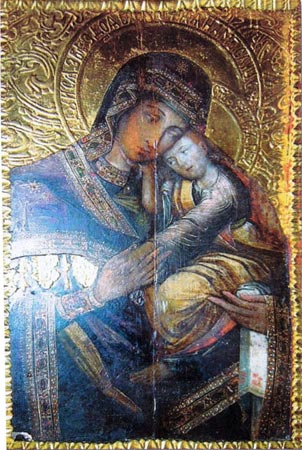
The "Umilenie-Tenderness" Pskovo-Pechersk Icon of the Mother of God, Икона Божией Матери «Челнская»

The "Umilenie-Tenderness" Pskovo-Pechersk Icon of the Mother of God
Commemorated on the 7th Sunday of Pascha, May 21, August 26, June 23, October 7
      The "Umilenie-Tenderness" Pskovo-Pechersk Icon of the Mother of God was written and brought to the Pskovo-Pechersk monastery through the efforts of the Pskov merchants Vasilii and Feodor in about the year 1521. It was glorified especially by miracles of healing in the year 1524. This holy icon and also the "Uspenie-Dormition" Icon were glorified in 1581 during the time of the siege of Pskov by the Polish king Stefan Bathory. The 7 October feastday of the "Umilenie" Icon was established in memory of the deliverance of Pskov from the invasion of Napoleon in 1812.
© 1996-2001 by translator Fr. S. Janos.

Икона Божией Матери ''Умиление'' Псково-Печерская
Икона Божией Матери «Челнская»
Дни памяти: в Неделю 7-ю по Пасхе
      В окрестностях уездного города Трубчевска Орловской губернии располагался старинный Спасо-Челнский мужской монастырь, основанный (по другим источникам, возобновленный) князем Трубчевским А. Н. в XVI в. По некоторым данным, монастырь существовал уже в конце XII в. В этой обители пребывала чудотворная Челнская икона Божией Матери.
      Старинное предание гласит о том, что святой образ Пресвятой Богородицы, плывший по реке Десне против течения в никем не управляемом челне, явился местному пастуху. Произошло это в том месте, где позднее был устроен монастырь. Благочестивые жители крестным ходом с почестями и благоговением перенесли явленную икону в местный приходской храм. Узнав о чудесном обретении святого образа, князь Трубчевский, который страдал от тяжкого недуга, повелел доставить себя к месту явления иконы Пресвятой Богородицы. После усердных молитв перед образом князь получил полное исцеление, а святая икона была помещена в построенной князем часовне, где прославилась многочисленными чудотворениями.
      После закрытия в 1923 году Трубчевского Челнского монастыря, следы чудотворной иконы Божией Матери теряются.
      В настоящее время список с Челнской иконы Пресвятой Богородицы находится в Трубчевской церкви Сретения Господня Брянской епархии.

Friday, 23 May 2014

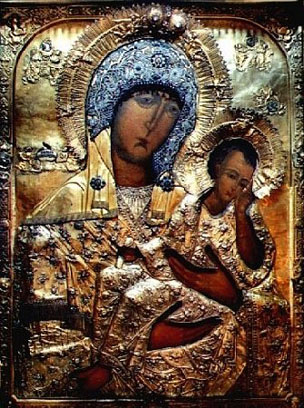
The Kievo-Bratsk Icon of the Mother of God Икона Божией Матери Киево-Братская

The Kievo-Bratsk Icon of the Mother of God
Commemorated on May 10, September 6, June 2
      The Kievo-Bratsk Icon of the Mother of God was situated at first in the Borisoglebsk church in the city of Vyshgorod (Kiev), where it miraculously appeared in the year 1654. In 1662, during the time of war of Russia with Poland (1659-1667), the city was dealt heavy losses by the Crimean Tatars fighting on the side of the Polish. The temple of the holy Passion-Bearers Boris and Gleb was destroyed and defiled. But the Providence of God preserved the holy wonderworking icon of the Mother of God, which was taken out of the church beforehand in time and set off along the Dniepr, and the relics of the saints they hid beneathe a crypt. The river carried the icon to the Podola river-bank at Kiev, where it was joyfully taken up by the Orthodox and with due reverence transferred to the Bratsk monastery. In the records of church property of the Kievo-Bratsk monastery, made in the year 1807, was given its description. There existed a "Song about the wonderworking Kievo-Bratsk Icon of the Mother of God", compiled soon after the year 1692.Celebration of the Kievo-Bratsk Icon of the Mother of God is made thrice within the year: 6 September, 10 May and 2 June. All these days are dedicated to the miraculous appearance of the holy icon in 1654. The original of the icon has not been preserved. The icon copy was written from it "measure for measure", and is at present located in the Kiev monastery of the Pokrov (Protection) of the Mother of God.
© 1996-2001 by translator Fr. S. Janos.
Икона Божией Матери Киево-Братская
Дни памяти: 10 мая, 6 сентября и 2 июня
      Киево-Братская икона Божией Матери прежде была местной в Борисоглебской церкви в городе Вышгороде (Киевском), где она чудесно явилась в 1654 году. В 1662 году, во время войны России с Польшей (1659-1667), городу был нанесен большой урон от воевавших на стороне поляков крымских татар. Храм святых страстотерпцев Бориса и Глеба был разорен и поруган. Однако Промысл Божий сохранил чудотворную икону Божией Матери, которую своевременно вынесли из храма и пустили по Днепру, а мощи святых сокрыли под спудом. Река вынесла икону к берегу Подола в Киеве, где она была с радостью принята православными и с подобающими почестями перенесена в Братский монастырь. Там она и оставалась в течение долгого времени. В описи церковного имущества Киево-Братского монастыря, сделанной в 1807 году, приводится ее описание.
      Существовала "Песнь о чудотворной Киево-Братской иконе Богоматери", составленная вскоре после 1692 года.
      Празднования Киево-Братской иконе Божией Матери свершаются трижды в году: 6 сентября, 10 мая и 2 июня. Все они посвящены чудесному явлению святой иконы в 1654 году.
      Подлинник иконы не сохранился. Писанная с нее икона "мера в меру" находится ныне в Киевском монастыре Покрова Божией Матери.  

Saturday, 17 May 2014

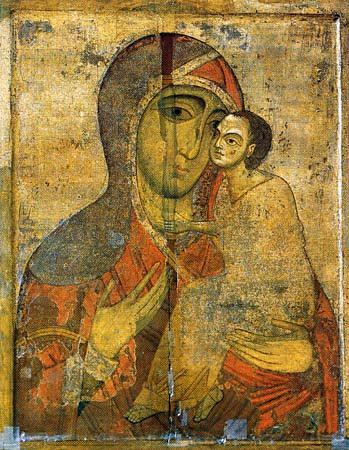
The Starorusskaya Icon of the Mother of God Старорусская икона Божией Матери

The Starorusskaya Icon of the Mother of God
Commemorated on May 4 and September 18
      The Starorusskaya Icon of the Mother of God was titled such because for a long time it was located Stara Russa, whither it had been brought by the Greeks from Olviopolis during the very first period of Christianity in Russia. The icon was situated in Stara Russa until the XVII Century. In 1655 during the time of a plague it was revealed to a certain inhabitant of the city of Tikhvin that the pestilence would cease, if the wonderworking Starorusskaya Icon were transferred there, and the Tikhvin Icon sent to Stara Russa. After the transfer of the icons the plague ceased, but the Tikhvin people did not return the icon and only in the XVIII Century did they give permission to make a copy from the Starorusskaya Icon, which on 4 May 1768 was sent to Stara Russa. A feast was established in honour of this event. On 17 September 1888 the original was also returned to Stara Russa and a second festal date established.
© 1996-2001 by translator Fr. S. Janos.


Старорусская икона Божией Матери
Дни памяти: 4 мая, 18 сентября
      Старорусская икона Божией Матери называется так потому, что она долгое время находилась в Старой Руссе, куда была принесена греками из Ольвиополя еще в первые времена христианства на Руси. В Старой Руссе икона находилась до ХVII века. Во время моровой язвы 1655 года одному жителю города Тихвина было откровение, что мор прекратится, если туда будет принесена чудотворная Старорусская икона, а Тихвинская икона будет отправлена в Старую Руссу. После перенесения икон мор прекратился, но тихвинцы не вернули иконы и лишь в ХVIII веке разрешили снять копию со Старорусской иконы, которая 4 мая 1768 года была привезена в Старую Руссу. В честь этого события было установлено празднество. 17 сентября 1888 года в Старую Руссу был возвращен и подлинник и установлена вторая праздничная дата.
Икона Божией Матери Старорусская

Friday, 16 May 2014

Свенская-Печерская икона Божией Матери The Svensk-Pechersk Icon of the Mother of God

Свенская-Печерская икона Божией Матери
Дни памяти: 3 мая
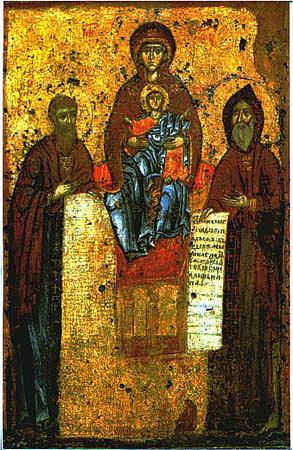
      Свенская-Печерская икона Божией Матери была написана преподобным Алипием Печерским († около 1114, память 17 августа). На иконе изображена Божия Матерь, сидящая на престоле, на коленях у Нее Богомладенец. Справа от трона стоит преподобный Феодосий, а слева - преподобный Антоний Печерские. До 1288 года она находилась в Киево-Печерском монастыре, где прославилась чудесами, и в 1288 году была перенесена в Брянский Свенский монастырь, в честь Успения Пресвятой Богородицы, следующим образом. Черниговский князь Роман Михайлович, будучи в Брянске, ослеп. Услышав о чудесах от иконы, писанной самим преподобным Алипием, князь послал в монастырь гонца с просьбой прислать к нему в Брянск икону для исцеления. Икону отправили вместе со священником по реке Десне. Во время плавания лодка пристала к правому берегу реки Свены. После ночевки путники утром пошли к лодке, чтобы помолиться иконе, но не нашли ее там, а увидели на горе против реки Свены. Икона стояла на дубе между ветвями. Весть об этом дошла до князя Романа; его привели к иконе пешком. Князь горячо молился и обещал построить на этом месте монастырь, отдав ему все земли, которые увидит с горы. После молитвы князь начал прозревать. Сначала он увидел тропинку, затем близкие предметы и, наконец, все окрестности. Приложившись к иконе, князь отслужил молебен, а затем все собравшиеся основали деревянный храм в честь Успения Пресвятой Богородицы. Дерево, на котором пребывала икона, срубили и употребили на доски для других икон. Тогда же было установлено празднество Свенской иконе Божией Матери 3 мая.
      Икона прославилась исцелениями слепых, бесноватых, заступничеством от врагов.
The Svensk-Pechersk Icon of the Mother of God
Commemorated on May 3
      The Svensk-Pechersk Icon of the Mother of God was written by the Monk Alypii of Pechersk (+ c. 1114, Comm. 17 August, under which see the account about him). On the icon is depicted the Mother of God, sitting upon a throne, and upon Her knees is the God-Infant. At the right side of the throne stands the Monk Theodosii, and on the left – the Monk Antonii of Pechersk. Until the year 1288 it was situated at the Kievo-Pechersk monastery, where it was glorified by miracles, and in 1288 it was transferred to the Bryansk Svensk monastery, named in honour of the Uspenie (Dormition) of the MostHoly Mother of God, in accord with the image. The Chernigov prince Roman Mikhailovich, then at Bryansk, fell blind. Hearing about the miracles worked by the icon of the Monk Alypii, the prince sent to the monastery a courier with a request to send him at Bryansk the icon for his healing. They dispatched the icon together with a priest along the River Desna. During the time of sailing the boat came in to land at the right bank of the River Svena. After lodging for the night they went to the boat to make prayers before the icon, but they did not find it there, and they saw it upon an hill opposite the River Svena. The icon stood on an oak amidst the branches. News of this reached prince Roman, and they led him to the icon on foot. The prince prayed fervently before the icon and vowed to build on that spot a monastery, bestowing on it all the land which could be seen from the hill. After the prayer the prince regained his sight. At first he saw the footpath, then nearby objects, and finally all the surroundings. Having made an enclosure for the icon, the prince had a molieben served, and then all that were gathered made the foundations for a wooden church in honour of the Uspenie of the MostHoly Mother of God. The tree, on which the icon set, they cut up and used as wood for other icons. And then was established a feastday of the Svensk Icon of the Mother of God on 3 May.
      The icon was glorified by healings of the blind, demoniacs, and was a protector from enemies.

© 1996-2001 by translator Fr. S. Janos.
http://www.russianchurchlondon.org/

The Pechersk Icon of the Mother of God with the Monks Antonii and Theodosii Печерская икона Божией Матери с предстоящими преподобными Антонием и Феодосием Печерскими

Печерская икона Божией Матери с предстоящими преподобными Антонием и Феодосием Печерскими
Дни памяти: 3 мая
      Печерская икона Божией Матери с предстоящими преподобными Антонием и Феодосием Печерскими изображает Божию Матерь сидящую на троне с короной на голове. Свои руки Она возлагает на коленопреклоненных преподобных Антония и Феодосия. На коленях у Божией Матери - Богомладенец, благословляющий обеими руками. По сторонам трона стоят склоненные Ангелы.

The Pechersk Icon of the Mother of God with the Monks Antonii and Theodosii
Commemorated on May 3
      The Pechersk Icon of the Mother of God with the Monks Antonii and Theodosii depicts the Mother of God sitting upon a throne with a crown upon Her head. Her hands She places upon the Monks Antonii and Theodosii upon bent knee. Upon the knees of the Mother of God – is the God-Infant, blessing with both hands. Along the sides of the throne are bowing Angels.

© 1996-2001 by translator Fr. S. Janos.

The Pechersk Not-Wrought-by-Hand Icon of the Mother of God 1085 Печерская-Нерукотворенная икона Божией Матери

The Pechersk Not-Wrought-by-Hand Icon of the Mother of God
Commemorated on May 3
      The Pechersk Not-Wrought-by-Hand Icon of the Mother of God appeared in the Great church of the Kievo-Pechersk monastery in the year 1085.
© 1996-2001 by translator Fr. S. Janos.
Печерская-Нерукотворенная икона Божией Матери
Дни памяти: 3 мая
      Печерская-Нерукотворенная икона Божией Матери явилась в Великой церкви Киево-Печерского монастыря в 1085 году.


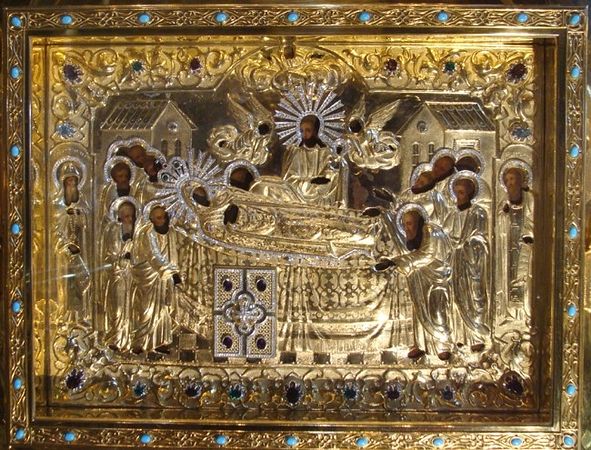
Киево-Печерская икона Успения Пресвятой Богородицы

Киево-Печерская икона Успения Пресвятой Богородицы The Kievo-Pechersk Icon of the Uspenie (Dormition) of the MostHoly Mother of God

 Киево-Печерская икона Успения Пресвятой Богородицы
Дни памяти: 3 мая, 15 августа
      Киево-Печерская икона Успения Пресвятой Богородицы - одна из древнейших явленных икон в Русской Православной Церкви. Пресвятая Богородица вручила ее 4-м византийским зодчим, которые в 1073 году принесли икону преподобным Антонию и Феодосию Печерским. Зодчие пришли в пещеру к преподобным и спросили: "Где хотите вы начать церковь?" Святые ответили: "Идите, Господь назначит место". - "Как вы, предсказывая себе скорую смерть, не назначили еще места? - удивились зодчие. - А еще дали нам столько золота". Тогда преподобные призвали всю братию и стали расспрашивать греков, говоря: "Скажите нам истину, кто вас послал и как вы попали сюда?" Зодчие стали рассказывать: "Однажды, когда мы спали в своих домах, рано, на восходе солнца, пришли к каждому из нас благообразные юноши и сказали: "Зовет вас Царица во Влахерну". Мы пришли все в одно время и, расспросивши друг друга, узнали, что ту же речь Царицы слышал каждый из нас и одни и те же посланные были за всеми нами. Наконец мы увидели Царицу со множеством воинов. Мы поклонились Ей, и Она сказала: "Я хочу построить Себе Церковь на Руси, в Киеве, и вот, велю вам это сделать. Возьмите золота на 3 года". - Мы же, поклонившись, спросили: "Госпожа, Царица! Ты посылаешь нас в чужую страну, к кому мы там придем?" - Она отвечала: "Я посылаю вас вот с ними, с Антонием и Феодосием". - Мы удивились: "Зачем же, Госпожа, Ты даешь нам золота на 3 года? Им и прикажи заботиться о нас, что нам есть и что пить, и нас одаришь, чем Сама знаешь". - Царица возразила: "Этот, Антоний, только благословит и отойдет от этого света в вечный покой. А этот, Феодосий, отойдет после него через 2 года. Итак, берите золота до избытка. А что до того, чтобы почтить вас, то никто не может сделать это так, как Я. Дам вам, чего и ухо не слышало, и глаз не видел и что на сердце человеку не всходило. Я Сама приду смотреть Церковь и буду в ней жить". - Она дала нам также мощи святых мучеников: Артемия, Полиевкта, Леонтия, Акакия, Арены, Иакова, Феодора - и сказала: "Это положите в основание". - Мы взяли золота больше, чем нам нужно было, и Она сказала: "Выйдите на двор, посмотрите величину Церкви". - Мы вышли и увидели Церковь на воздухе. Вошедши опять к Царице, мы поклонились и сказали: "Госпожа Царица, какое имя Церкви?" - Она ответила: "Я хочу назвать ее Своим Именем". - Мы не смели спросить, как Ее Имя, но Она опять сказала Сама: "Богородицына будет Церковь". - И, давши нам эту икону, сказала: "Она будет в ней наместной". Мы поклонились Ей и пошли в свои дома, неся с собой икону, полученную из рук Царицы". Выслушав это, все прославили Бога, и преподобный Антоний сказал: "Дети, мы никогда не выходили из этого места. Звавшие вас благообразные юноши были святые Ангелы, а Царица во Влахерне - Сама Пресвятая Богородица. А что до нашего образа и данного как бы через нас золота, то Господь ведает, как Он изволил сотворить это со Своими рабами. Благословен приход ваш, добрую спутницу вы имеете, честную икону Госпожи". Три дня молился преподобный Антоний, чтобы Господь Сам указал ему место для церкви. После первой ночи по всей земле была роса, а на святом месте сухо. На другое утро по всей земле было сухо, а на святом месте роса. На третье утро, помолившись, благословили место и измерили золотым поясом ширину и длину церкви. (Этот пояс еще давно принес варяг Шимон, которому было видение о постройке церкви.) Огонь, спадший с неба по молитве преподобного Антония, указал, что Богу угодно начинание. Так было положено начало Божественной Церкви.
      Икона Успения Пресвятой Богородицы прославилась чудесами. Два друга, Иоанн и Сергий, побратались перед ней. Спустя много лет Иоанн смертельно заболел. Он отдал свою часть имущества в Печерский монастырь, а часть 5-летнего сына передал на сохранение Сергию; ему же отдал и сына Захарию на попечение. Когда Захарии исполнилось 15 лет, он захотел взять принадлежавшее ему имущество, но Сергий упорно говорил, что Иоанн все роздал нищим. Он дошел до того, что пришел в Успенскую церковь и поклялся перед чудотворной иконой, что не брал ничего. Когда он захотел поцеловать икону, то не смог приблизиться к ней; пошел к дверям и вдруг закричал: "Святые Антоний и Феодосий! Не велите убивать меня этому немилостивому и молитесь Госпоже Пресвятой Богородице, чтобы Она отогнала от меня это множество бесов, которым я предан. Пусть берут золото и серебро: оно запечатано в моей клети". Захария отдал все имущество в Печерский монастырь, где и сам постригся. С тех пор никому не давали клясться чудотворной иконой. Икона не раз защищала страну от нашествия врагов. В 1677 году, когда турки осаждали Чигирин и Киеву грозила опасность, икону почти в течение всего дня 27 августа обносили вокруг города. Богородица благословляла русские войска, шедшие на Полтавскую битву 1709 г.). В 1812 году икону снова обносили вокруг Киева. Празднование иконе положено дважды в год: 3 мая и 15 августа.
Киево-Печерская икона Успения Пресвятой Богородицы 
The Kievo-Pechersk Icon of the Uspenie (Dormition) of the MostHoly Mother of God
Commemorated on May 3, August 15
      The Kievo-Pechersk Icon of the Uspenie (Dormition) of the MostHoly Mother of God – is one of the most anciently appeared icons in the Russian Orthodox Church. The MostHoly Mother of God entrusted it to 4 Byzantine architects, who in 1073 brought the icon to the Monks Antonii and Theodosii of Pechersk. The architects arrived at the cave of the monks and asked: "Where do ye want to begin the church?" The saints answered: "Go, the Lord will point out the place". "How is it that ye, anticipating impending death, have still not designated the place? – wondered the architects – And still they have given us so much gold". Then the monks called together all the brethren and they began to question the Greeks, saying: "Tell us the truth, who sent you and how did ye wind up hereabouts?". The architects started by saying: "One time, when each of us was asleep in our own homes, early – at sunrise, handsome youths came to us and said: "The Queen doth summon you to Blakhernae". We all arrived at the same time and, in questioning one another we learned, that each of us had heard this command of the Queen and that those sent out had come to all of us. Finally, we beheld the Queen of Heaven with a multitude of warriors. We bowed down to Her, and She said: "I want to build Myself a Church in Rus', at Kiev, and herewith I do bid ye to do this. Take sufficient gold for 3 years". We however, having bowed ourselves down, asked: "Lady Queen! Thou dost send us to a foreign land, – to whom there art we to go?" – She answered: "I send you to these here, to Antonii and Theodosii". – We wondered: "Why then, Lady, dost Thou give us gold for 3 years? With it bid also what concerns us, what we shalt eat and what we shalt drink, and provide us also with what Thou knowest about it". The Queen replied: "This one, Antonii, wilt give only but the blessing and expire from this world into eternal repose. And the other one, Theodosii, wilt follow him after 2 years. Wherefore, take gold abundantly sufficing. And moreover, to esteem you, know that no one is able to do this such as I shall. I shalt give ye, what neither ear hath heard, nor what eye hath seen nor what in heart hath been in ascent for man. I Myself shalt come to look upon the Church and I shalt dwell within it". – She likewise gave us relics of the Holy Martyrs: Artemios, Polyeuktos, Leontios, Akakios, Aretha, James, Theodore, and said: "This place ye within the foundation". – We took gold more than enough, and She said: "Come out the doorway, and behold the resplendid Church". – We went out and beheld a Church in the air. Having come in again to the Queen, we bowed down and said: "Lady Queen, what wilt be the name of the Church?" – She answered: "I wish to call it by Mine Own Name". – We did not dare to ask, what Her Name was, but She Herself again said: "It wilt be the Church of the Mother of God". – And, having given us this icon, She said: "This wilt be put within it". We bowed down to Her and went to our own homes, taking with us the icon, received from the hands of the Queen".
      Having heard this account, all glorified God, and the Monk Antonii said: "My children, we never ventured out of this place. Those handsome youths summoning you were holy angels, and the Queen in Blakhernae – was the MostHoly Mother of God Herself. And what regards our image and the gold given as through us, that the Lord only knoweth, how He deigned to do this with His servants. Blest be your arrival, ye have good accompaniment, the venerable icon of the Lady". For three days the Monk Antonii prayed, that the Lord Himself would show him the place for the church. After the first night there was a dew throughout all the land, but dry on the holy spot. On the second morning throughout all the land it was dry, but on the holy spot it was with dew. And on the third morning, having prayed, they blessed the place and measured out with a golden sash the width and length of the church. (This sash had long before been brought by the Varangian Shimon, who had a vision about the building of a church). A firebolt, falling from heaven through the prayer of the Monk Antonii, indicated that what was designated was pleasing to God. Thus was placed the foundation of the Divine Church.
      The icon of the Mother of God was glorified by numerous miracles. Two friends, John and Sergei, sealed their friendship before it. After many years John fell mortally ill. He gave part of his wealth to the Pechersk monastery, and the portion for his 5 year old son he gave over for safekeeping to Sergei; he gave over to him also his son Zakharii under his guardianship. When Zakharii turned age 15, he wanted to receive the inheritance belonging to him, but Sergei persisted in saying, that John had distributed off everything to the poor. He persisted to such an extent, that he went into the Uspensk church and vowed before the wonderworking icon, that he had taken nothing. When he made attempt to kiss the icon, he was not able to come near it; he went to the doors and suddenly shouted out: "Holy Antonii and Theodosii! Let me not be struck down for this dishonesty, pray ye the MostHoly Mother of God, that She drive away from me this multitude of demons, to which I am given over. Let the gold and silver be taken away: it is sealed away in my granary". Zakharii gave off all his inheritance to the Pechersk monastery, where he also himself took monastic vows. And from that time no one would take oaths at the wonderworking icon.
      The icon more than once defended the land from invasion of enemies. In 1677, when the Turks laid siege to Chigirin and danger threatened Kiev, they carried the icon around the city for almost the entire course of the day of 27 August. The Mother of God blessed Russian armies going to the Battle of Poltava (1709). In 1812 they again carried the icon around Kiev. The celebration of the icon is set twice within the year: 3 May and 15 August.
© 1996-2001 by translator Fr. S. Janos.
http://www.russianchurchlondon.org/
Thursday, 15 May 2014

The Putivl'sk Icon of the Mother of God / Икона Божией Матери Путивльская

The Putivl'sk Icon of the Mother of God / Икона Божией Матери Путивльская

Commemorated on May 2

The Putivl'sk Icon of the Mother of God appeared on 2 May 1635 in the city of Putivl' of Kursk region on the city's Nikol'sk gates (by s
ome sources, the icon was first appeared in the year 1238). The wonderworking image was for a long time situated on the city-gates and glorified by numerous miracles and signs.

© 1996-2001 by translator Fr. S. Janos.

Икона Божией Матери Путивльская

Дни памяти: 2 мая
Икона Божией Матери Путивльская явилась 2 мая 1635 года в городе Путивле Курской области у бывших Никольских ворот (по некоторым источникам, икона была впервые явлена в 1238 году). Чудотворный образ долгое время находился на городских воротах и прославился многочисленными чудотворениями и знамениями.

Икона Божией Матери Путивльская явилась 2 мая 1635 года в городе Путивле Курской области у бывших Никольских ворот (по некоторым источникам, икона была впервые явлена в 1238 году). Чудотворный образ долгое время находился на городских воротах и прославился многочисленными чудотворениями и знамениями.


http://drevo-info.ru/articles/7137.html
http://days.pravoslavie.ru/Life/life978.htm
http://www.russianchurchlondon.org/calendar/

Sunday, 20 April 2014

Византийская икона Божией Матери / The Byzantine Icon of the Mother of God

The Byzantine Icon of the Mother of God
Commemorated on April 7, May 1
      The Byzantine Icon of the Mother of God appeared on 7 April 732. It was transferred to Russia from Rome.
© 1996-2001 by translator Fr. S. Janos.
  
Византийская икона Божией Матери
Дни памяти: 7 апреля, 1 мая
      Византийская икона Божией Матери явилась 7 апреля 732 года. В Россию была перенесена из Рима. 

Thursday, 17 April 2014

Икона Божией Матери, именуемая Геронтисса / The Icon of the Mother of God, named "Gerontissa"

 Икона Божией Матери, именуемая Геронтисса
Дни памяти: 4 апреля
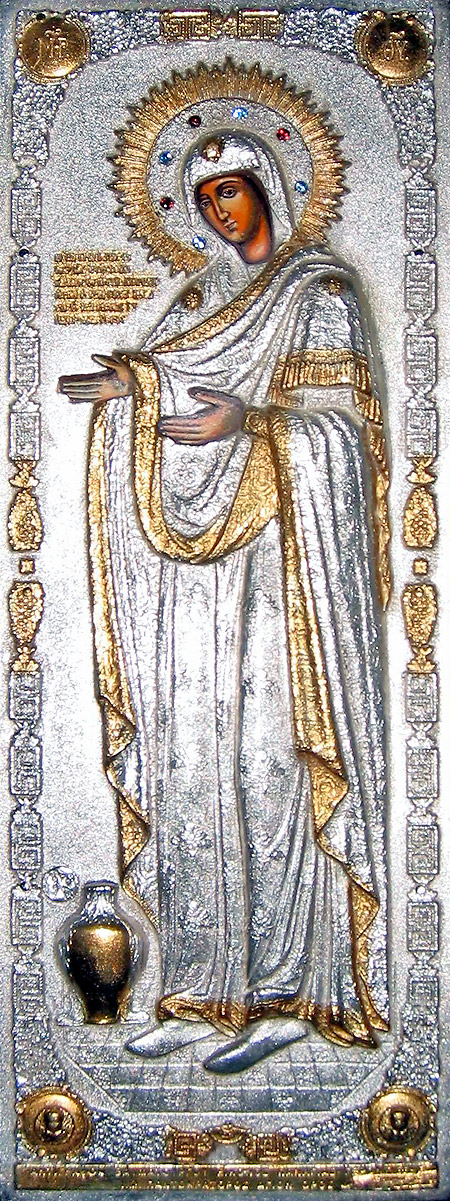
      Икона Божией Матери, именуемая Геронтисса (Старица - Настоятельница), прославилась в Афонском монастыре Пантократор (Вседержитель).
      Благочестивый игумен-старец той обители получил откровение о своей близкой кончине. Перед смертью он хотел причаститься Святых Христовых Таин и попросил служащего священника поторопиться совершить Божественную литургию, но тот не внял его просьбе. Тогда от чудотворной иконы Геронтиссы, стоявшей в алтаре, был услышан грозный глас, повелевший священнику поторопиться исполнить желание своего игумена.
      Другое чудо от иконы совершилось, когда по молитве настоятеля обители в пустых монастырских сосудах умножился елей.
      На иконе Матерь Божия изображается в полный рост без Богомладенца. Перед Нею сосуд, из которого изливается через края елей.
      Известна икона Божией Матери Геронтиссы в алтаре соборного храма Успенской Почаевской Лавры. По благословению архиепископа Волынского и Житомирского Модеста священнослужители перед началом богослужения испрашивали перед иконою Матери Божией благословение на начало службы.  
 
The Icon of the Mother of God, named "Gerontissa"
Commemorated on April 4
      The Icon of the Mother of God, named "Gerontissa" ("Staritsa" – "Nastoyatel'nitsa", "Head" – "Elderess"), was glorified in the Athos monastery of the Pantokrator ("Vsederzhitel'", "Ruler of All").
      The pious hegumen-elder of this monastery received a revelation about his impending end. Before death he wanted to be communed the Holy Mysteries of Christ and he besought of the serving priest to hasten to make the Divine Liturgy, but that one did not heed his request. Then from the wonderworking Gerontissa Icon in the altar was heard a fiercesome voice, ordering the priest to hasten to fulfill the wish of his hegumen.
      Another miracle from the icon occurred, when through the prayer of the head of the monastery, oil appeared in empty monastic vessels.
      On the icon, the Mother of God is imaged in full stature without the Christ-Child. Before Her is a vessel, from which oil pours out over the edge.
      An icon of the Gerontissa Mother of God is known of in the altar of the Uspenie-Dormition cathedral church in the Pochaev Lavra. Through the blessing of Archbishop Modest of Volynsk and Zhitomir, priest-servers before the start of Divine-services asked the blessing for the start of services in front of the Icon of the Mother of God.
© 1996-2001 by translator Fr. S. Janos.
http://www.russianchurchlondon.org/en/calendar/

The Icon of the Mother of God "Deliveress" / Икона Божией Матери "Избавительница"

The Icon of the Mother of God "Deliveress"
Commemorated on April 4, October 17
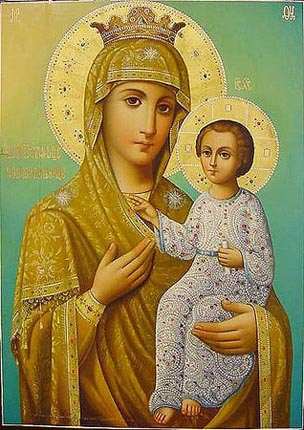
      The Icon of the Mother of God "Deliveress", before being brought to the Novo‑Athonsk Simono-Kananitsk monastery in the Caucasus, was situated on Holy Mount Athos with a resident of the Russian Panteleimonov monastery, schemamonk Martinian (+ 1884). The pious schemamonk had received this icon from the ascetic, Theodoul. The holy icon was glorified by miracles from times of old. Through prayer before this icon in 1841 the inhabitants of Sparta (in Greece) were delivered from locusts. From the Panteleimonov monastery, upon the final wishes of schemamonk Makarii, on 20 July 1889 this icon was given over to the Novo-Athonsk monastery, and the festal celebration in honour of it established under 17 October. When the feastday in honour of this icon was first made at the Simono-Kananitsk monastery, a storm cast up on shore at the monastery more than a ton of fish. On the icon the Most Holy Mother of God holds on Her right arm the God-Infant, Who blesses with His right hand.
© 1996-2001 by translator Fr. S. Janos

The Icon of the
Mother of God "Deliveress"
Икона Божией Матери "Избавительница"
Дни памяти: 4 апреля, 17 октября
      Икона Божией Матери "Избавительница" до того, как была принесена в Ново-Афонский Симоно-Кананитский монастырь на Кавказе, находилась на Святой Горе Афон у насельника Русского Пантелеимонова монастыря схимонаха Мартиниана (+ 1884). Благочестивый схимник получил эту икону от подвижника Феодула. Святая икона прославилась чудотворениями с давних времен. По молитве перед этой иконой в 1841 году жители Спарты (в Греции) избавились от саранчи. Из Пантелеимоновой обители, по завещанию схиархимандрита Макария, эта икона 20 июля 1889 года была передана Ново-Афонской обители, и было установлено празднество в честь ее 17 октября. Когда в Симоно-Кананитской обители впервые совершилось празднество в честь этой иконы, буря выбросила на берег у монастыря более тонны рыбы. На иконе Пресвятая Богородица изображена держащей на правой руке Богомладенца, благословляющего десницей.  

икона Божьей матери «ИЗБАВИТЕЛЬНИЦА»

Wednesday, 16 April 2014

Икона Божией Матери "Неувядаемый Цвет". /The Icon of the MostHoly Mother of God, "Unfading Blossom" ("Neuvyadaemii Tsvet"):

The Icon of the MostHoly Mother of God, "Unfading Blossom" ("Neuvyadaemii Tsvet"):
Commemorated on April 3
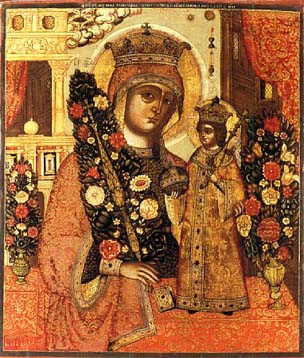
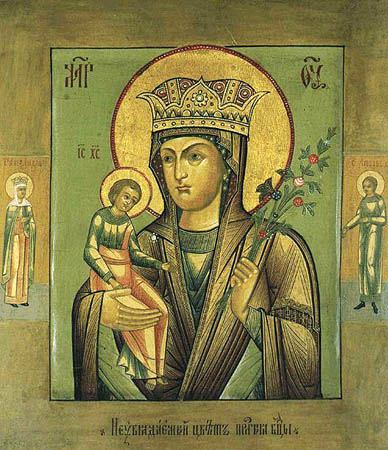
      The Icon of the MostHoly Mother of God, "Unfading Blossom" ("Neuvyadaemii Tsvet"): On this icon the MostHoly Mother of God holds Her Divine Son upon Her right arm, and in Her left hand – is a bouquet of white lilies. This bouquet symbolically signifies the unfading flower of virginity and immaculateness of the All-Pure Virgin, to Whom thus also Holy Church turns: "Thou art the Root of virginity and the Unfading Blossom of purity". Copies of this icon were glorified at Moscow, Voronezh and other locales of the Russian Church.
© 1996-2001 by translator Fr. S. Janos.
The Icon of the
MostHoly Mother of God, "Unfading Blossom" ("Neuvyadaemii
Tsvet"):

Икона Божией Матери "Неувядаемый Цвет".
Дни памяти: 3 апреля
      Икона Божией Матери "Неувядаемый Цвет". На иконе Пресвятая Богородица держит Своего Божественного Сына на правой руке, а в левой руке у Нее - цветок белой лилии. Этот цветок символически знаменует неувядаемый цвет девства и непорочности Пречистой Девы, к Которой так и обращается Святая Церковь: "Ты еси Корень девства и Неувядаемый Цвет чистоты". Списки этой иконы прославились в Москве, Воронеже и других местах Русской Церкви.  
Икона Божией Матери ''Неувядаемый цвет''

http://www.russianchurchlondon.org/en/calendar/

Sunday, 13 April 2014

Иверская икона, The Iversk Icon of the Mother of God

The Iversk Icon of the Mother of God
Commemorated on March 31, February 12, October 13 and on Tuesday of the Bright Week
      The Iversk Icon of the Mother of God (which at present is preserved on Athos) was in the IX Century situated with a certain pious widow, living near Nicea. During the time of the emperor Theophilos (82-842), the Iconoclasts in their attempts to abolish the veneration of holy icons, came to the house of this Christian, and one of the soldiers struck the image of the Mother of God with a spear. Where it was struck, there immediately flowed out blood. The widow, fearing its destruction, promised the imperial soldiers money and implored them not to touch the icon until morning. When the soldiers departed, the woman together with her son (later to be an Athos monk), sent the holy icon away upon the sea to preserve it. The icon, standing upon the water, floated off to Athos. The Athos monks, having for several days seen a fiery pillar rising up to the heavens upon the sea, came down to the shore and found there the holy image, standing upon the waters. After a molieben of thanksgiving for the monastery having been granted the holy image that thus had appeared, a pious monk of the Iveria monastery – Saint Gabriel the Gruzian (Georgian, Comm. 12 July) – had a sleep vision in which the Mother of God appeared to him and gave him orders, and so he went to the water and taking up the holy icon he placed it in the church. On the following day, however, the icon was found not within the church, but on the gates of the monastery. This was repeated several times, until the MostHoly Mother of God revealed to Saint Gabriel Her will, saying, that She did not want the icon as something protected by the monks, but rather She intended to be their Protectress. After this, the image was installed atop the monastery gates. And therefore this icon came to be called "Portal–Keeper" or "Gate-Keeper" (An account about this icon is located also under 13 October).
© 1996-2001 by translator Fr. S. Janos.
 Иверская икона
Дни памяти: 31 марта, 12 февраля, 13 октября и во вторник Светлой седмицы
      Иверская икона (которая сейчас хранится на Афоне) в IХ веке находилась у одной благочестивой вдовы, жившей близ города Никеи. При императоре Феофиле (829-842) иконоборцы, уничтожавшие святые иконы, пришли в дом этой христианки, и один воин копьем ударил по образу Богородицы. Тотчас из пораженного места потекла кровь. Вдова, боясь уничтожения святыни, пообещала императорским воинам деньги и просила их до утра не трогать икону. Когда они ушли, женщина вместе с сыном (впоследствии афонским иноком), для сохранения святой иконы опустила ее в море. Икона, стоя на воде, приплыла к Афону. Афонские иноки, несколько дней видя в море огненный столп, восходящий до неба, пришли к берегу и нашли святой образ, стоящий на воде.
      После молебна о даровании монастырю явившейся святыни благочестивый инок Иверского монастыря святой Гавриил Грузин (память 12 июля), по повелению Божией Матери, явившейся ему во сне, пошел по воде, принял святую икону и поставил в храме.


      Однако на следующий день икона была обретена не в храме, а над воротами обители. Так повторялось несколько раз, пока Пресвятая Дева не открыла святому Гавриилу Свою волю во сне, сказав, что не желает быть хранимой иноками, а хочет быть их Хранительницей. После этого образ был поставлен над монастырскими воротами. Поэтому святая икона называется Портаитиссою, Вратарницею. (Сведения об иконе помещены также 13 октября.)

Sunday, 6 April 2014

Икона Божией Матери "Тучная Гора" / The Icon of the Mother of God "the Beclouded Mount" (Tuchnaya Gora)

The Icon of the Mother of God "the Beclouded Mount" (Tuchnaya Gora)
Commemorated on March 24
      The Icon of the Mother of God "the Beclouded Mount" (Tuchnaya Gora): About 250-300 years ago this icon was situated in one of the men's monasteries of Tver' and was presented by the superiour to Kosma Volchaninov in gratitude for the fine completion of work in the monastery church. This icon as an holy thing was passed on from generation to generation, but a certain impious grandson of Kosma removed it hanging the icon in an attic. His bride endured many insults from her husband and his relatives. In despair over her marriage she resolved to end it by suicide in a deserted bath-house. On the way there a monk appeared to her and said: "Whither goest thou, unhappy one? Return back; go, pray to the Mother of God of the Beclouded Mountain – and thou wilt live fine and in peace". The agitated young wife, having returned home, told everything, not concealing even her interrupted intention. They started to search for the monk, but they did not find him, and no one besides her had seen him. This took place on the eve of the feast of the Annunciation to the MostHoly Mother of God. They immediately found the icon in the attic, cleaned off the dirt and set it up in the house in a place of veneration. In the evening the parish priest was invited, who made before the icon the all-night vigil, which from that time was done annually in the house on this day. For more than 150 years the icon was situated in the Volchaninov family. Ekatherina, daughter of Vasilii, the last of the Volchaninov line, entered into marriage with Georgii Ivanovich Konyaev, taking with her the icon of the Mother of god as a very dear inheritance. And in the Konyaev house moliebens and all-night vigils were done on 24 March and 7 November (probably, this was the day of the transfer of the icon from the monastery to the house of Kosma Volchaninov).

      In 1863 near a cemetery church of the Smolensk Icon of the Mother of God it was decided to build a chapel in honour of Sainted Tikhon and the Monk Makarii of Kalyazinsk. The then owner of the icon, Georgii Konyaev (+ 1868, at age 97) wanted to bestow the health-bearing image of the Mother of God to the church. He turned to the clergy with a request to build still another chapel for the wonderworking image of the Mother of God of the "Beclouded Mount". Along with this he said: "I feel the very best place for it is the temple of the Smolensk Icon of the Mother of God, since the place on which the church was built, in olden times was called a Mount, as being the very highest place in the city. On this Mount in former times the inhabitants in time of flood took up their possessions and here saved themselves from ruin. Let the Queen of Heaven – the BeClouded Mountain – rest with your blessing upon this mountain and let all here buried be veiled with Her mercy". On 15 July 1866 the icon was transferred into the constructed chapel, which on the following day was consecrated by the Staritsk bishop Antonii.
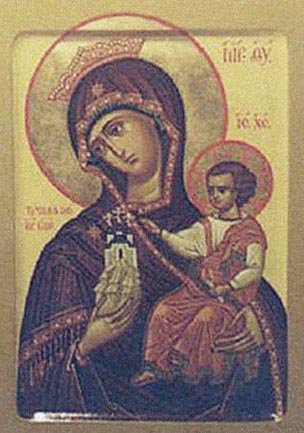
      On the icon the Most Holy Mother of God is depicted standing on an half-circle elevation – a mountain; upon Her left arm – the Divine-Infant with blessing right hand. Upon the head of the Mother of God is a crown, and in Her hand a not-large mountain, on which are seen above churches with cupolas and crosses.
© 1996-2001 by translator Fr. S. Janos.

Icon of the Mother of God "Fat Mountain"
Bronnikova C.
  
Икона Божией Матери "Тучная Гора"
Дни памяти: 24 марта
      Икона Божией Матери "Тучная Гора". Около 250-300 лет тому назад эта икона находилась в одном из мужских монастырей Твери и подарена была настоятелем Косме Волчанинову в благодарность за хорошо исполненные работы в монастырском храме. Эта икона как святыня передавалась из поколения в поколение, но один неблагоговейный внук Космы вынес обветшавшую икону на чердак. Его невестка терпела много оскорблений от мужа и его родных. В отчаянии женщина решила покончить самоубийством в пустой бане. На пути ей явился какой-то монах и сказал: "Куда ты, несчастная, идешь? Воротись назад; иди, помолись Божией Матери Тучной Горе - и будешь жить хорошо и покойно". Взволнованная молодая женщина, возвратившись домой, рассказала все, не скрывая и своего преступного намерения. Стали разыскивать монаха, но не нашли его, никто кроме нее его не видел. Случилось это накануне праздника Благовещения Пресвятой Богородицы. Икону немедленно отыскали на чердаке, отчистили от грязи и поставили в доме на почетном месте. Вечером был приглашен приходской священник, который совершил пред иконой всенощное бдение, которое с тех пор совершалось в доме ежегодно в этот день. Более полутораста лет икона находилась в семье Волчаниновых. Екатерина, дочь Василия, последнего из рода Волчаниновых, выйдя замуж за Георгия Ивановича Коняева, взяла к себе икону Матери Божией как самое дорогое наследие. И в доме Коняева перед этой иконой совершались молебствия и всенощные бдения 24 марта и 7 ноября (вероятно, это был день перенесения иконы из монастыря в дом Космы Волчанинова).

      В 1863 году при кладбищенской церкви Смоленской иконы Божией Матери было решено устроить придел в честь святителя Тихона и преподобного Макария Калязинского. Тогдашний владелец иконы, Георгий Коняев († 1868, в возрасте 97 лет) пожелал передать цельбоносный образ Богородицы в храм. Он обратился к причту с просьбой устроить еще один придел для чудотворного образа Матери Божией "Тучная Гора". При этом он сказал: "Я считаю самым лучшим для нее храм Смоленской иконы Божией Матери, потому что место, на котором построена церковь, в старину называлось горой, как самое высокое место в городе. На эту гору в прежнее время жители во время наводнений сносили свое имущество и здесь спасались сами от погибели. Пусть же Царица Небесная - Тучная Гора - почивает своей благодатью на этой горе и покрывает всех здесь погребенных Своей милостью". 15 июля 1866 года икона была перенесена в построенный придел, который на следующий день был освящен Старицким епископом Антонием.
      На иконе Пресвятая Богородица изображена стоящей на полукруглом возвышении - горе; на левой руке Ее - Богомладенец с благословляющей десницей. На главе Богоматери корона, а в руке небольшая гора, на которой виден верх церкви с куполами и крестами.

Thursday, 27 March 2014

The Theodorov (Feodorov) - Kostroma Icon of the Mother of God

The Theodorov (Feodorov) - Kostroma Icon of the Mother of God
Commemorated on March 14, August 16
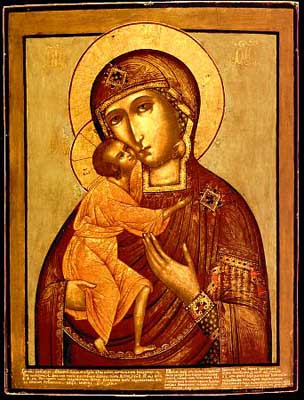
      The Theodorov (Feodorov) - Kostroma Icon of the Mother of God was written by the Evangelist Luke and is close in iconography to the Vladmir Icon of the Mother of God.
      This icon received its name from GreatPrince Yaroslav Vsevolodovich (+ 1246), the father of Saint Alexander Nevsky, and who received in holy Baptism the name Theodore (Feodor) – in honour of Saint Theodore Stratelates. It was found, according to tradition, by his elder brother, Saint Yurii Vsevolodovich (+ 1238, Comm. 4 February), in an old wooden chaplet near the old city of Gorodets – later on at this spot was built the Gorodetsk Theodorov monastery. Prince Yaroslav-Theodore became the GreatPrince of Vladimir after his brother Saint Yurii perished in battle with the Tatar-Mongols at the Sita River, and subsequently in the year 1239, he solemnly transferred the relics of his brother from Rostov to the Vladimir Uspenie (Dormition) cathedral. And with this same icon inherited from his brother, he blessed his own son, Saint Alexander Nevsky, who that very year entered into marriage with the daughter of the Polovetsian prince Briacheslav.

      Yaroslav-Theodore left behind in Russian history a remarkable memory of himself. He continued with the glorious traditions of his uncle – Saint Andrei Bogoliubsky (Comm. 4 July), and of his father – Vsevolod III Big-Nest ("Bol'shoe Gnezdo"), and he was thus connected to almost all of the significant events in the history of Rus' in the first half of the XIII Century. He inherited the legacy of Rus', burnt and hacked apart in the years 1237-1238 by the Tatar-Mongols. He raised it up from the ashes, rebuilt and embellished the cities, the holy monasteries and the churches. He restored cities along the Volga devastated by the enemy: Kashin, Uglich, Yaroslavl', Kostroma, Gorodets. The church of Theodore Stratelates at Kostroma and the Theodorov monastery near Gorodets were founded by him in honour of his patron saint. For all of eight years he stood at the helm as greatprince, but during this while he had to guide the land through a singularly difficult path for these times – maintaining a military-political balance with the Golden Horde to the East, while mounting an active opposition to Catholic Europe in the West. His closest companion was his son, Saint Alexander Nevsky, who also continued his governing policy.
      The wonderworking Theodorov Icon of the Mother of God – with the blessing of his father – was constantly with Saint Alexander, and it was his prayer-icon. After his death (Saint Alexander Nevsky died on 14 November 1263 in Gorodets, at the monastery founded by his father), the icon was taken by his younger brother Vasilii.
      Vasilii Yaroslavich was the "little-est", that is, he was the youngest (eighth) son of Yaroslav Vsevolodovich. In 1246 after the death of his father, (prince Yaroslav was poisoned in the capital city of Mongolia – Karakorum), when he was but five years old, he became prince of the Kostroma appanage-holding – the least important in the domains of his father. But in the year 1272 God destined for him to become GreatPrince of Vladimir. His four years as greatprince (1272-1276) were filled with the typical for these times princely fratricidal quarrels. For several years he waged war against Novgorod with an unruly nephew Dimitrii Alexandrovich. In becoming greatprince, however, Vasilii did not journey off to Vladimir, but remained under the protection of the wonderworking icon at Kostroma, regarding this place more hopeful in case of new outbreaks of strife. 
Икона Божией Матери Феодоровская

      He had occasion also to defend Rus' against external enemies. In 1272, during the course of a Tatar incursion, a Russian army came forth from Kostroma to engage them. On the example of his grandfather, Saint Andrei Bogoliubsky – who took with him on military campaigns the wonderworking Vladimir Icon of the Mother of God, – prince Vasilii went off into battle with the wonderworking Theodorov Icon. Bright rays shot out from the holy image, striking the enemy; the Tatars were routed and expelled from the Russian land.
      The chronicles relate, the GreatPrince Vasilii had an especial love for the Church and the clergy. After the martyr's death of the Vladimir bishop Mitrophan during the storming of Vladimir by Tatars on 4 February 1238, the Vladimir diocese had for a long period of years remained as though widowed. This grieved GreatPrince Vasilii. With his help in 1274 there was constructed in Vladimir the large Cathedral church. This was apparently in connection with the consecration as bishop of Vladimir of Sainted Serapion (+ 1275, Comm. 12 July) – who was an hegumen from Pechersk; this was presided over by Metropolitan Kirill III (+ 1282) and a sobor-council of Russian hierarchs. The purpose of the council's actions was quite extensive – this was the first Sobor in the Russian Church since the time of the Mongol invasion. Many a problem and disorder had arisen in church life, but the Russian Church was just barely beginning to recover from the woe that had befallen it. A chief task for it was the rebirth of Russian churchly literacy, and the restoration of the tradition of the ancient Russian "princely order". Without books the salvific activity of the Church would be well nigh impossible: they were needed for the Divine-services, and for preaching, for cell meditation by monks, and for at-home reading by believers. With the efforts of Metropolitan Kirill together with the Russian bishops and monk-scholars, this task, – the most important for the subsequent Christian enlightenment of Rus', was successfully undertaken. The Sobor adopted a new redaction of the essential books – the fundamental canonical codex of Orthodox churchly life.
      In the year 1276 prince Vasilii finished his life's journey, the most important steps along the way of which were beneathe the overshadowing blessing of the Theodorov Icon of the Mother of God. He died at Kostroma and there also found the place of his final rest. The holy icon has been from that time in the Kostroma cathedral of Saint Theodore Stratelates.
      Renewed interest in the Theodorov Icon of the Mother of God and the wide spreading about of its veneration throughout all Russia is connected with events of the beginning of the XVII Century – with the cessation of the Time of Troubles. In the year 1613 the wonderworking Theodorov Icon from the Kostroma cathedral was used in blessing the selection of Mikhail Romanov as the new tsar. In memory of this historic event there was established under 14 March the general commemoration of the Theodorovsk Icon of the Mother of God. Numerous copies were made from the Kostroma Theodorovsk Icon, and one of the first was commissioned and brought to Moscow by the mother of tsar Mikhail – the nun Martha. From the second half of the XVII Century, various copies of the Theodorov Icon received an enlargement with vignettes, depicting events from the history of the wonderworking icon.
      In the year 1670 the monk-deacon Longin from the Kostroma Ipat'ev monastery wrote the "Narrative concerning the manifestations and miracles of the Theodorov Icon of the Mother of God in Kostroma". Not all the things contained in its information co-incides with things previously stated, reflecting the people's memory as regarding chronology and laws.
      The Theodorov Icon is two-sided. On the reverse side – is the image of the holy GreatMartyress Paraskeva, depicted in the splendid attire of a princess. It is conjectured, that the image of Paraskeva on the reverse of the icon is connected with the spouse of Saint Alexander Nevsky.   
© 1996-2001 by translator Fr. S. Janos. 

Saturday, 22 March 2014

The Albazinsk Icon of the Mother of God "Word made Flesh"

The Albazinsk Icon of the Mother of God "Word made Flesh"
Commemorated on March 9
      The Albazinsk Icon of the Mother of God "Word made Flesh" – is of great religious significance in the Amur River region. It received its name from the Russian fortress of Albazin (now the village of Albazino) along the Amur river, founded in the year 1650 by the famous Russian frontier ataman Erofei Khabarov on the site of a settlement of the Daurian prince Albaza.
      The hue arising over the Amur Albazinsk fortress became an object of enmity for the Chinese emperor and his generals, who then already dreamed of expanding their influence over all of Russian Siberia.
      On the eve of the feast of the Annunciation / Blagoveschenie, on 24 March 1652, there occurred the first military clash of the Russians with the Chinese at the Amur. Through the prayers of the MostHoly Mother of God the pagans were scattered and fled to their own territory. This victory appeared as a blessed portent for the Russians. But the struggle had only just begun. Still many a son of Holy Rus' went on to drain the cup of death in the struggle for the Amur – for the triumph of Orthodoxy in the Far East.
      In June of 1658 an Albazinsk military detachment, 270 Cossacks under the leadership of Onufrei Stepanov, fell into an ambush and in an heroic fight they were completely annihilated by the Chinese.
      The enemy burned Albazin, overran Russian lands, and carried off into China the local population. They wanted to turn the fertile cultivated area back into wilderness.

      During these difficult years the MostHoly Mother of God shew particular signs of Her mercy unto the Amur land. In 1665, when Russians returned and rebuilt Albazin, together with a priest there came to the Amur the starets/elder Ermogen from the Kirensk Holy Trinity monastery; he carried with him a blessing to regenerate the region, – a wonderworking icon of the Mother of God "the Word made Flesh", called since that time the Albazinsk Icon. In 1671 the blessed elder built on the boundary mark of the Brusyan Stone (one and an half kilometers from Albazin nearby along the Amur) a small monastery, where also was kept the holy icon during the following years.
      Albazin was built up. At two churches in the city – the Ascension of the Lord and Sainted Nicholas the Wonderworker – Albazinsk priests raised up the Bloodless Sacrifice. Not far from the city (up along the Amur) was built still another monastery, – the Spassky. The fertile soil produced bread for all Eastern Siberia. The local populace adapted itself to Russian Orthodox culture, peacefully entering into the assemblage of the multi-national Russian state, and found Russian protection from the plundering raids of Chinese feudal war-lords.
      At Moscow they did not forget the needs of the far-away Amur frontier: they strengthened military defenses and improved regional governance. In 1682 was formed the Albazinsk Military-Provincial Government. They concerned themselves about the spiritual nourishment of the Amur region peoples. A local Sobor / Council of the Russian Church in 1681 adopted a resolution about the sending to the far-off city on the Lena and Amur, "to the Daurian people", "religious – archimandrites, hegumens or priests, both learned and good,  for the enlightening of unbelievers with the law of Christ". The Daurian and Tungusian peoples as a whole accepted Holy Baptism; of great significance was the conversion to Orthodoxy of the Daurian prince Hantimur, – christened Peter, and his eldest son Katana, – christened Paul.
      The servants of the Chinese emperor planned among themselves for a new attack. After several unsuccessful forays, on 10 July 1685, they marched against Albazin with an army numbering 15 thousand and encircled the fortress. In it were 450 Russian soldiers and 3 cannon. The first assault was repulsed. The Chinese then from all sides piled up firewood and kindling against the wooden walls of the fortress and set it afire. Further resistance proved impossible. With its military standards and holy things, among which was the wonderworking Albazinsk Icon, the garrison in military array abandoned the fortress.
      But the Mother of God did not withhold Her intercession from Her chosen city. Scouts soon reported, that the Chinese suddenly "hurriedly both day and night" began to withdraw from Albazin, not even being able to fulfill the Chinese emperor's command to destroy the sown crops of the Russian fields. The miraculous interference of the Heavenly Protectress not only expelled the enemy from Russian territories, – it even preserved the bread, which then sufficed the restored city for the winter months. On 20 August 1685 Russians were again already in Albazin.
Икона Божией Матери ''Слово плоть бысть''
      A year went by, and the fortress was again besieged by Chinese. There began an heroic five-month defense of Albazin, – "the Albazinsk sitting-tight", which occupies a most honoured place in the history of Russian military glory. Thrice – in July, in September and in October, – the forces of the Chinese emperor made an assault on the wooden fortifications. An hail of fiery arrows and red-hot cannon balls fell on the town. The battle was such, that neither the city nor its defenders could be seen in the smoke and fire. And all three times the Invisible Protectress, the Mother of God, defended the Albazinsk inhabitants from their fierce enemy.
      Until December 1686, when the Chinese, – having acknowledged their inability to succeed – lifted the siege of Albazin, in the city of its 826 defenders only 150 men remained alive.
      These forces were inadequate to continue the war against the Chinese emperor. In August 1690 the last of the Cossacks, under the leadership of Vasilii Smirenikov – one of the heroes of the defense of Albazin, departed from Albazin. Neither the fortress, nor its holy things, fell into the hands of the enemy: the fortifications were razed and leveled by the Cossacks, and the Albazinsk Icon of the Mother of God was taken to Sretensk, a city on the river Shilka, which flows into the Amur.
      But even after the destruction of Albazin, God destined its inhabitants to fulfill yet another service for the good of the Church. By Divine Providence the cessation of the military effort contributed to the increase of the influence of the grace of Orthodoxy among the peoples of the Far East. During the years of war, a company of about an hundred Russian cossacks and peasants from Albazin and its environs were taken captive and dispatched to Peking. The Chinese emperor even gave orders to give over one of the Buddhist temples for establishing in the Chinese capital an Orthodox church in the name of Sophia, the Wisdom of God. In 1695 the metropolitan of Tobol'sk, Ignatii, sent off to the Sophia church – antimins, chrism, Divine-service books and church vessels. In a missive to the captive priest Maksim, "the Preacher of the Holy Gospel to the Chinese Empire", Metropolitan Ignatii wrote: "Be thou not troubled, nor hereafter troubled of soul for thyself and all captive with thee, – since who is able to oppose the Will of God? And captivity for you is not without purpose to the Chinese people, such that the light of Christ's Orthodox Faith may be revealed to them by you".
      The preaching of the Gospel in the Chinese empire soon bore fruit – and resulted in the first baptisms of Chinese. The Russian Church zealously concerned itself over the new flock. The metropolitan of Tobol'sk, Sainted Philothei – "the Apostle to Siberia" (+1727), in 1715 wrote a grammota to the Peking clergy and the faithful living under the Peking Spiritual Mission, having uninterruptedly continued with the Christian work of enlightening pagans up through the then present time.
      The years went by, and the new epoch brought with it the Russian deliverance of the Amur. In the year 1850 on 1 August, on the feast of the All-Merciful Saviour, captain G. I. Nevel'sky raised up the Russian Andreev flag at the mouth of the Amur River and founded the city of Nikolaevsk-on-Amur. Through the efforts of the Governor-General of Eastern Siberia, N. N. Murav'ev-Amursky (+ 1881), and the holy Equal-to-the-Apostles Innokentii, ArchBishop of Kamchatka (+ 1879, Comm. 31 March), and through the spiritual nourishment which obtained in the Amur and Sea-coast regions, – in several years all the left bank of the Amur was built up with Russian cities, villages and cossack settlements. Each year brought important advances in the development of the liberated territory, its Christian enlightenment and welfare. In the year 1857 on the bank of the Amur were established fifteen way-stations and settlements (among which number the larger, – the Albazinsk on the site of the old fortress and the Innokentiev, named in honour of Sainted Innokentii). So too for the single year 1858 were more than thirty settlements, among which were three cities, – Khabarovsk, Blagoveschensk and Sophiisk.
      In May 1858, on the day of holy Sainted Nicholas the God-Pleasing, N. N. Murav'ev-Amursky and ArchBishop Innokentii of Kamchatka arrived in the cossack post at Ust'-Zeisk. Sainted Innokentii was here to dedicate a temple in honour of the Annunciation / Blagoveschenie of the Mother of God, – the first building in the new city. Because of the name of the temple, the city was also called Blagoveschensk, – in memory of the first victory over the Chinese on the feast of the Annunciation in 1652, and in memory of the Blagoveschenie church at Irkutsk, – in which Sainted Innokentii began his own priestly service; but it was also as a symbol, that "from hence hath proceeded the blessed news of the re-integration of the Amur region territory under Russian sovereignty". New settlers on the way to the Amur, journeying through Sretensk, fervently offered up their prayers to the Holy Protectress of the Amur region in front of her Wonderworking Albazinsk Icon. Their prayers were heard: the Aigunsk (1858) and Peking (1860) treaties decisively secured for Russia the left-bank of the Amur and Sea-coast regions.
      In 1868 the bishop of Kamchatka, Benjamin Blagonravov – the successor to Sainted Innokentii, transferred the holy icon from Sretensk to Blagoveschensk, thereby returning to the Amur territory its famous holy icon. A new period in the veneration of the Albazinsk Icon of the Mother of God began with the year 1885 and is associated with the name of the Kamchatka bishop Gurii, who established an annual commemoration on 9 March and a weekly reading of an akathist with prayerful song.
      ... In the summer of 1900, during the time of the "Boxer Rebellion" in China, the waves of insurrection reached all the way to the Russian border. Chinese troops suddenly appeared on the banks of the Amur in front of peaceful Blagoveschensk. For nineteen days the enemy stood before the undefended city, raining artillery fire down upon it, and menacing the Russian bank with invasion. The shallows of the Amur afforded passage to the adversary. But in the Blagoveschensk church the services were incessant, and akathists were read before the Wonderworking Albazinsk Icon. And the Protection of the Mother of God, just like in earlier times of battles over Albazin, was again extended over the city: not daring to cross over the Amur, the enemy departed from Blagoveschensk. Through the accounts of the Chinese themselves, they often saw by day over the bank of the Amur a Radiant Woman, inspiring them with insuppressible fear and depriving their projectiles of destructive power.
      For more than 300 years the Wonderworking Albazinsk Icon of the Mother of God watched over the Amur frontier of Russia. Orthodox people venerate it not only as Protectress of Russian soldiers, but also as a Patroness of mothers. Believers pray before the icon for mothers during the time of their pregnancy and at childbirth, – "so that the Mother of God might give the true gift of abundant health from the inexhaustible well-spring of holiness of the Albazinsk Icon".

© 1996-2001 by translator Fr. S. Janos.

Friday, 21 March 2014

Курская икона Знамение Божией Матери,The Kursk Znamenie (Sign) Icon of the Mother of God

The Kursk Znamenie (Sign) Icon of the Mother of God
Commemorated on March 8, September 8, November 27 and on the 9th Friday of Pascha
      The Kursk Znamenie (Sign) Icon of the Mother of God – is one of the most ancient icons of the Russian Church. In the XIII Century during the time of the Tatar invasion, when all the Russian realm was put to the extremest tribulation, the city of Kursk, ravaged by the Horde of Batu, fell into desolation. One day in the environs of the city an hunter noticed the ancient icon, lying on a root face downwards to the ground. The hunter lifted it and saw that the image of the icon was similar to the Novgorod "Znamenie" Icon. With the appearance of this icon immediately there appeared its first miracle. Just as the hunter lifted up the holy icon from the earth, right then, at that place where the icon lay, gushed up strongly a spring of pure water. This occurred on 8 September 1259. The hunter decided not to leave the icon in the forest and settled on as a resting place an ancient small chapel, in which he put the newly-appeared image of the Mother of God. Soon inhabitants of the city of Ryl'a heard about this, and being in location not far away, they began to visit the place of the appearance for venerating the new holy image.

      They transferred the icon to Ryl'a and put it in a new church in honour of the Nativity of the MostHoly Mother of God. But the icon did not long remain there. It disappeared and returned to its former place of appearance. The inhabitants of Ryl'a repeatedly took it and carried it to the city, but the icon incomprehensibly returned to its former place. Everyone then realised, that the Mother of God preferred the place of appearance of Her Image. The especial help granted by the Mother of God through this icon is bound up with important events in Russian history: with the war of liberation of the Russian nation during the time of the Polish-Lithuanian incursion in 1612, and the 1812 Fatherland war. From the icon several copies were made, which also were glorified.
© 1996-2001 by translator Fr. S. Janos.
Курская икона Знамение Божией Матери
Дни памяти: 8 марта, 8 сентября, 27 ноября и в 9-ю пятницу по Пасхе
    Курская икона Знамение Божией Матери - одна из древнейших икон Русской Церкви. В ХIII веке, во время татарского нашествия, когда все Русское государство испытывало величайшее бедствие, город Курск, разоренный полчищами Батыя, пришел в запустение. Однажды в окрестностях города один охотник заметил лежавшую у корней дерева икону, обращенную ликом к земле. Охотник поднял ее к увидел, что изображение иконы подобно иконе "Знамение" Новгородской. Одновременно с явлением этой иконы совершилось и первое чудо. Как только охотник поднял святую икону с земли, тотчас на месте, где лежала икона, с силой забил источник чистой воды. Это произошло 8 сентября 1259 года. Охотник не решился оставить икону в лесу и построил на месте обретения небольшую деревянную часовню, и в ней поставил новоявленный образ Богоматери.


    Вскоре об этом узнали жители города Рыльска, расположенного неподалеку, и стали посещать место явления для поклонения новой святыне.
Икону перенесли в Рыльск и поставили в новом храме в честь Рождества Пресвятой Богородицы. Но икона пробыла там недолго, чудесным образом она исчезла и возвратилась на прежнее место явления. Жители Рыльска неоднократно брали ее и относили в город, но икона непостижимым образом возвращалась на прежнее место. Тогда все поняли, что Богоматерь благоволит к месту явления Своего образа.
Особая помощь Божией Матери через эту икону связана с важными событиями в истории России: освободительной войной русского народа во время польско-литовского нашествия 1612 года и Отечественной войной 1812 года. С иконы было сделано несколько списков, которые также прославились.

http://www.russianchurchlondon.org/en/calendar/